Establish the decision
Define the intended action, audience and questions the experience must answer.

Conversion Psychology
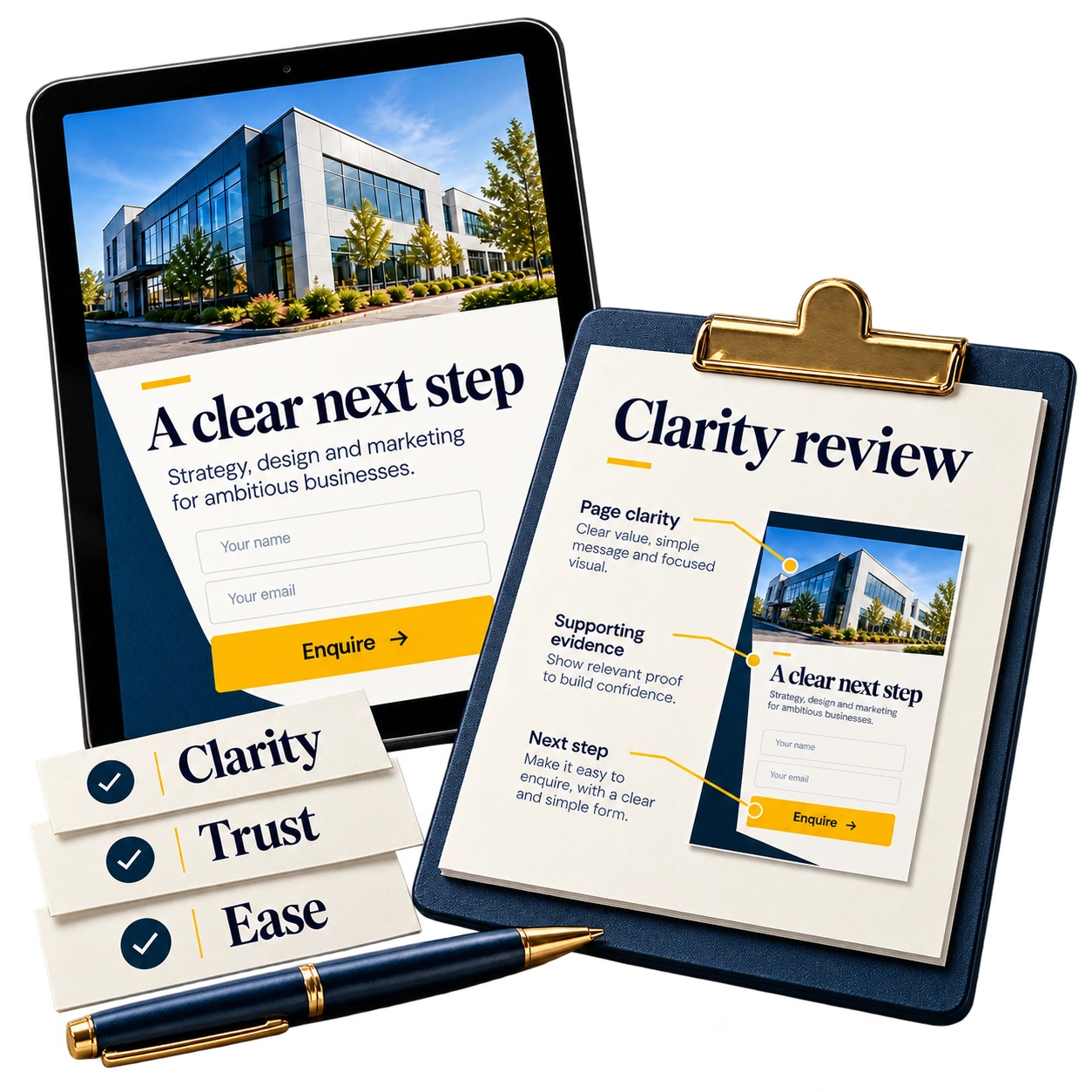
When visitors hesitate, a new button colour may not address the real problem. I review how the offer, evidence, page structure and interactions support a decision, then prioritise recommendations that improve clarity and reduce avoidable effort. The aim is informed, voluntary action.
Recognise the situation
The outcome
The agreed output can be an annotated review, a list of decision barriers and a prioritised set of recommendations. These recommendations are informed hypotheses, not proof of a conversion uplift. Design changes, implementation and measured testing are separate unless expressly included.
For example, a booking page may describe the service but omit what happens after a request. A review might recommend clearer expectations before changing the form. This is an illustrative assessment, not a claim about an existing client or its results.
Possible scope
Services can be commissioned separately or combined. The proposal identifies the actual deliverables, client inputs and responsibilities.
The process
Define the intended action, audience and questions the experience must answer.
Examine messages, evidence, structure, forms and interactions against that decision.
Separate observed issues from assumptions and explain which recommendations deserve attention.
Decide whether to commission copy, design, implementation or an appropriate measurement plan.
Your starting material
Scope and responsibilities
This is a practical marketing and experience review, not clinical psychology or a claim to predict individual behaviour. It does not include fabricated evidence, deceptive interfaces, false urgency or pressure tactics. Research depth, copy revisions, accessibility remediation, implementation and testing are agreed separately.
You remain responsible for accurate business and product facts, permission to share material, and approvals. Any tools, access, third-party costs and ongoing responsibilities are confirmed in the scope. If evidence is unavailable, that limitation is recorded rather than filled with invented results.
Frequently asked questions
No. The aim is to help appropriate visitors understand the offer and make an informed choice, including deciding that it is not right for them.
Existing evidence is useful, but its availability and limitations are recorded. An experience review can identify questions and barriers without presenting assumptions as measured findings.
Not automatically. Testing requires suitable traffic, reliable measurement and feasible tools. Any experiment design, setup and monitoring must be expressly agreed.
Funnels connects the stages of the journey. Conversion Psychology assesses how clearly a stage supports a decision through its message, evidence and interactions.
The initial scope may stop at assessment and recommendations. Copy, design and development can be quoted separately or included explicitly in a wider project.
Related services
Explore Funnels if the stages themselves need connecting. Use Marketing Strategy when the offer or audience is unsettled, and Website Design when an agreed recommendation needs page production. HBSOS explains the wider shared business and brand foundation.
Human-led diagnosis and Brand Seed work are available through Digital Mastery. The broader HBSOS software platform remains in development; these focused services do not require access to it.
A practical first step
Share what you offer, who you want to reach and where the current experience becomes difficult. I’ll review the enquiry and ask the questions needed to establish a proposed scope and investment.